

LAMYA GARGASH
A GOLDEN THREAD THROUGH SPACE AND SPIRIT
BY SOPHIE MAYUKO ARNI
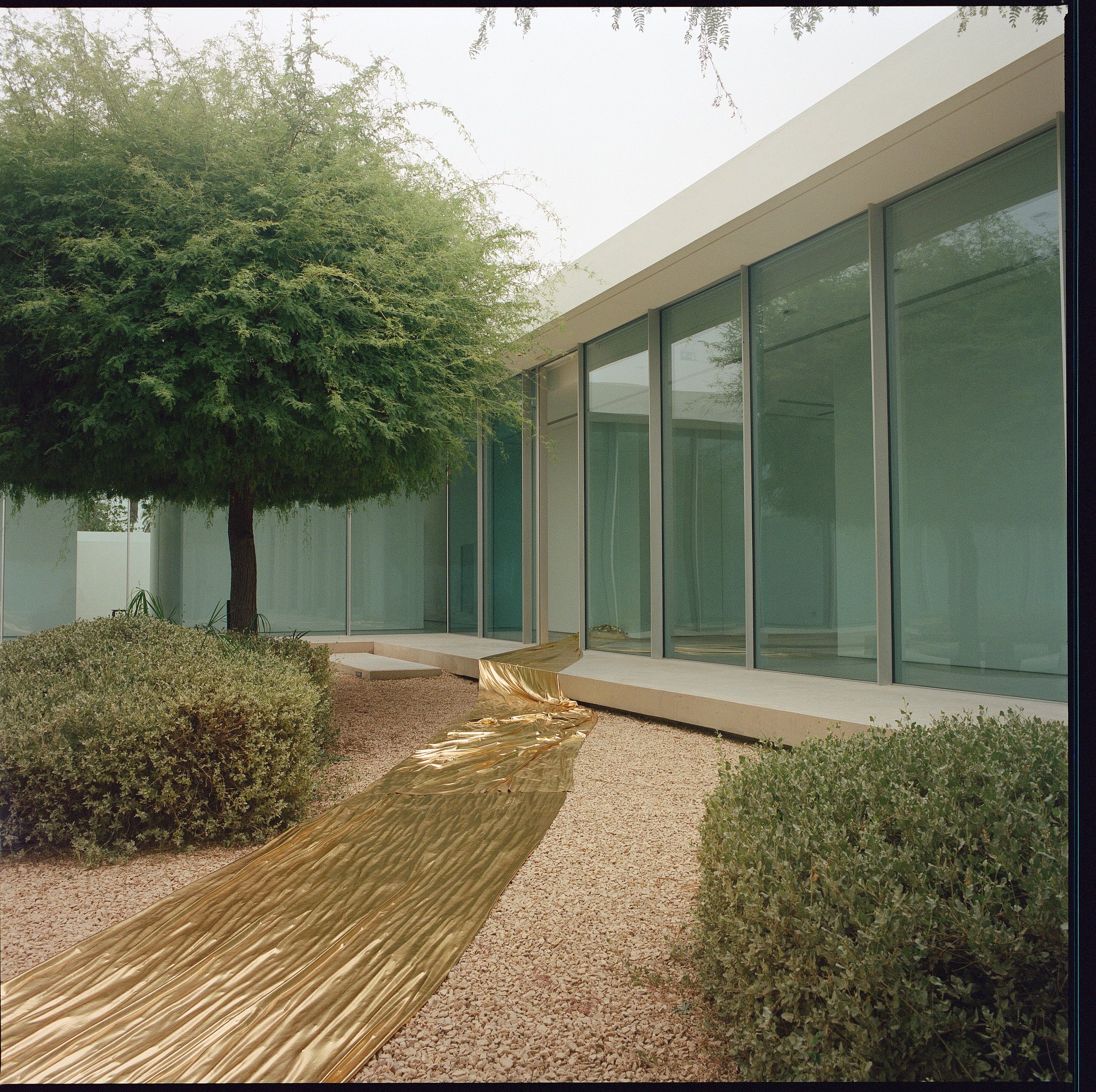
Al Hamriyah Studios, from the Kun series (2024)
Since representing the UAE at the Venice Biennale in 2009 — marking the Emirates’ first national pavilion — Lamya Gargash has steadily evolved her photographic practice, particularly in her hometown of Dubai. From archaeological museums and cultural institutions to artists’ homes, hotels, and officers’ clubs, Gargash has led us across the Emirates through her anthropological lens.
The quiet, attentive labor of decorating a space demands dedication to a repetitive craft. Décor is a choice, a decision to remain in a place and adorn it, a choice to claim a space as your own. With meticulous precision, Gargash highlights the legacy of significant interiors and the human presence revealed in choices of interiors and accumulated belongings.
For her new series Kun (“To Be”), also the title of her solo exhibition at Sharjah’s Maraya Art Centre, curated by Cima Azzam, Gargash takes a new direction. Turning to staged photography, she introduces a new element: a gold fabric that points to the Qiblah compass. Transporting the fabric from Dubai to Sharjah, and to the historic halls of London and Bath, always pointing in the same direction, the series guides viewers toward a metaphoric light. It is a gilded path — straight, unapologetic, connecting, and inviting to all.
The gold fabric symbolizes the artist’s maturity, an important moment in her long career as one of the region’s leading fine art photographers. The accompanying photographs and the discussion that follows explore her cultural heritage and the strength she has found in spiritual awakening. They serve as a reminder that strength comes through repetition. Daily rituals lead to clarity about who we are and where we’re headed.
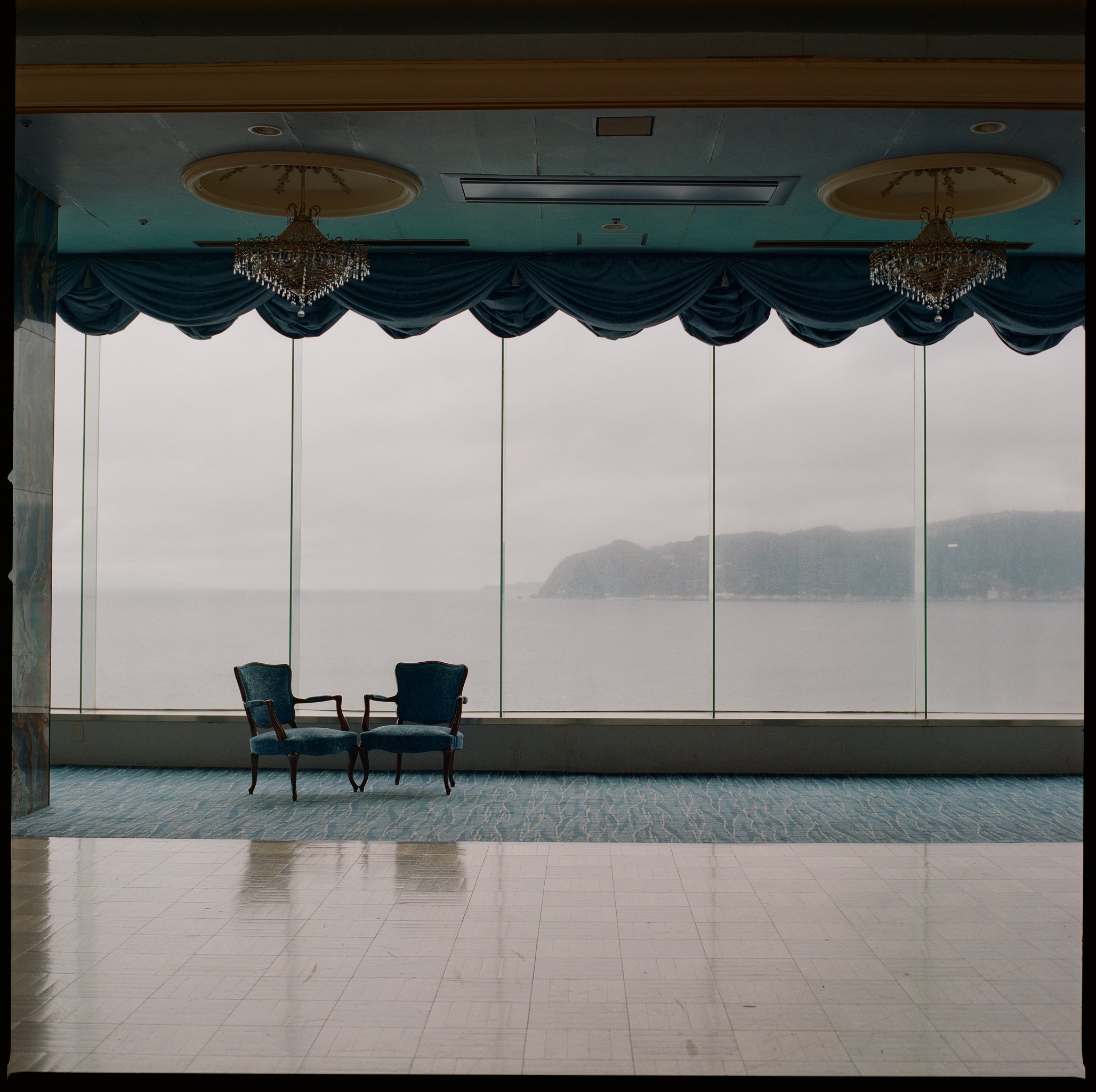
A Meaningful Conversation, from the Atami series (2022)
Sophie Mayuko Arni: I’d like to begin with ornamentation and the act of framing, which I see as a constant in your work. You frame your photographs so precisely that viewers imagine alternative spaces within the windows, doors, corridors, and picture frames. I remember the word nafs came up while we were conceptualizing your last solo exhibition at The Third Line, understanding your photographs as windows to the soul. Do you agree that the frame gives meaning to the core idea it encloses? Do you consciously look for frames when shooting?
Lamya Gargash: People often assume photography is just the click of a button. But it takes a great deal of energy, time, and patience to capture a single image. Of course, you also need an eye for it. Many focus on software and filters, but the image should stand out on its own merit. I take my time in spaces, studying every corner and angle to find what resonates emotionally and translates through the viewfinder. I don’t shoot for the sake of it — especially when working with film, which limits the number of shots and is expensive. Immersing myself in a space is meditative. I block out the noise. Patience and diligence are essential. You want people to engage with your work, not just find it “pretty” and forget it moments later. A powerful image lingers — it evokes emotion and asks to be taken seriously.
Framing, lighting, elements included or excluded, the angle; it all shapes the story. You can shift the meaning of a photograph simply by removing an object or changing the time of day. As an artist, you control the emotional and narrative tone, but you must always ask yourself: What am I trying to say? It took me years to find my voice. Simplicity and authenticity are the hardest things to achieve in personal work and art. To de-condition what we’ve been conditioned to accept requires deep self-reflection and acceptance.
SMA: Going back to the beginning, how did you first get into photography?
LG: Photography wasn’t my initial path. It came to me unexpectedly, but it kept returning no matter how much I tried to step away, like a loyal companion. It truly is my destiny.
I first encountered it through an analog photography class. I actually tried to drop the course, but it was a required prerequisite. I decided to push through — and to my surprise, I found joy in looking through the viewfinder and developing prints in the darkroom. That joy stuck with me, even as I tried to get away from it. A similar situation happened when I applied for my Master’s in Communication Design at Central Saint Martins, in London. I kept returning to photography.
Working with film at a time when digital took over has been tough. I’ve felt like I was swimming against the tide, but I’ve never been one to follow the herd. For nearly two decades, film has offered a charm and aesthetic that digital can’t replicate. Tradition plays a significant role in my work. I’ve long studied the presence and narratives of humans in space, especially in my home city.
Since I began this journey, I’ve gone through many life changes, including becoming a mother and experiencing loss. Despite all this, I’ve clung to the beauty around me, savouring and holding onto fleeting moments. I’ve always felt that an undocumented moment is a lost piece of our shared humanity.
…
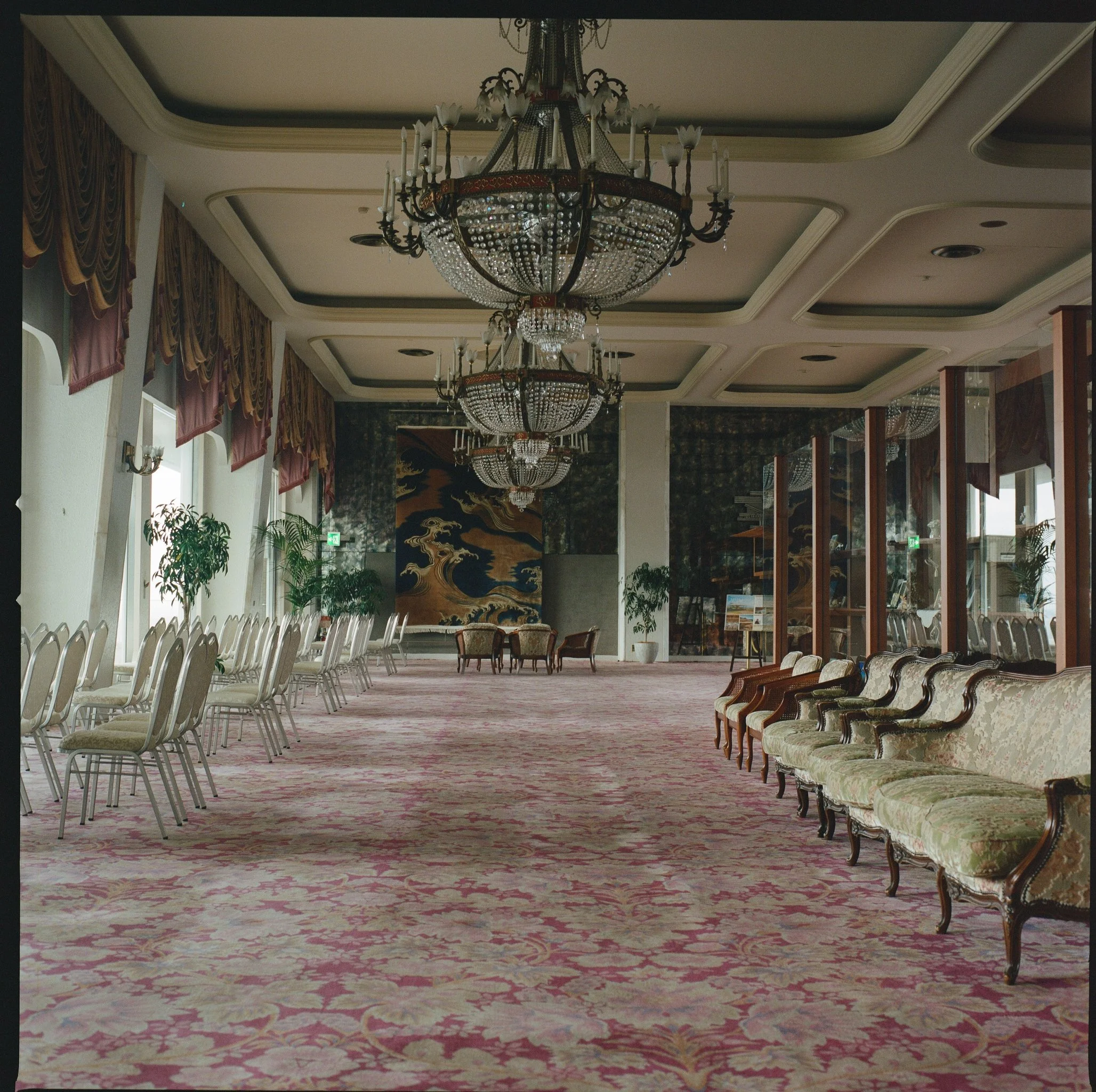
A Trio of Chavndeliers, from the Atami series (2022)
SMA: Your latest exhibition Kun, at Maraya Art Centre, introduces a new photographic series, in which you “intervene,” so to speak, in the compositions with the inserted element of the gold fabric pointing toward the Qiblah. How did this idea come about?
LG: This idea had been with me for over fifteen years, but it wasn’t the right time. Once I found my grounding, emotionally and mentally, I felt ready. Of course, working beyond your comfort zone is scary, but fear means you’re passionate and growing. I’m finally at peace with who I am. Spirituality plays a huge role in my life and I wanted to create a body of work that exemplified that and connects humans through spirituality, like the golden-draped fabric that runs through the photographs. Kun, meaning “to be” in Arabic, is a divine command in Islam: Be, and it is. It’s a small word, but so powerful. The idea of submission to God and letting things be emphasizes our human vulnerabilities and the beauty of this submission to the divine nurturing power.
This work speaks to spiritual yearning, which exists in many of us. I wanted to create something that emphasized spiritual transcendence through spaces that were typically considered unconventionally spiritual. The notion is that spirituality can be experienced in all spaces; there are no rules regarding the matters of the soul.
Hierarchies don’t exist when it comes to this personal spiritual pilgrimage; everyone’s journey is different. You can have a spiritual experience in a museum or in your bedroom. I wanted to evoke this sacred human experience through this aureate fabric, which aesthetically symbolizes a golden river that connects all spaces; and, in turn, connects us in our humanity.
SMA: The gold drape links cities like Dubai, Sharjah, London, and Bath through a shared sense of spirituality.
LG: Like a beacon of hope. This project connects cities through this flowing, golden fabric. Like my show “Isthmus,” which linked Dubai and Atami in Japan, this one centers on kinship and unity. The Qiblah compass anchors the work by symbolizing spirituality, direction, and unity.
Liminal spaces offer growth. They’re thresholds, both literal and figurative, beyond a sensory threshold. You embark on a journey that bridges the gap between what we have been conditioned to consider holy, peculiar, outlandish, commercial, and secular. This project crosses those boundaries, between conventional and unconventional. It creates new ways of seeing.
SMA: Tell us more about the connecting element of the fabric and the Qiblah it follows.
LG: The gold fabric is like a river flowing through each scene — softening the frame, guiding the eye, linking cities and humans. It brings romanticism, mysticism, and cohesion in a world that seeks to divide us. It also breaks the stillness of the frame, concealing, transforming, and focusing whatever it touches. It also serves as a curatorial cornerstone for the spatial arrangement of the work.
I had envisioned this for years, always wanting to integrate the Qiblah, but like faith, it took time. This was one of the most physically demanding projects of my two-decade career, lugging fabric and gear, often in buildings without elevators. It broke me down. But the passion drove me. The beauty in the journey is just as magical as the final outcome; and I had an incredible group of women who helped bring it to life.
This project isn’t limited to grand or prestigious institutions. It includes schools, homes, museums, theaters — spaces large and small. Spirituality isn’t bound by setting. These unconventional intimate places are just as sacred.
I plan to keep expanding this work, linking my home to cities around the world and embrace our shared humanity. Its goal is to foster a sense of unity that transcends geographical borders.
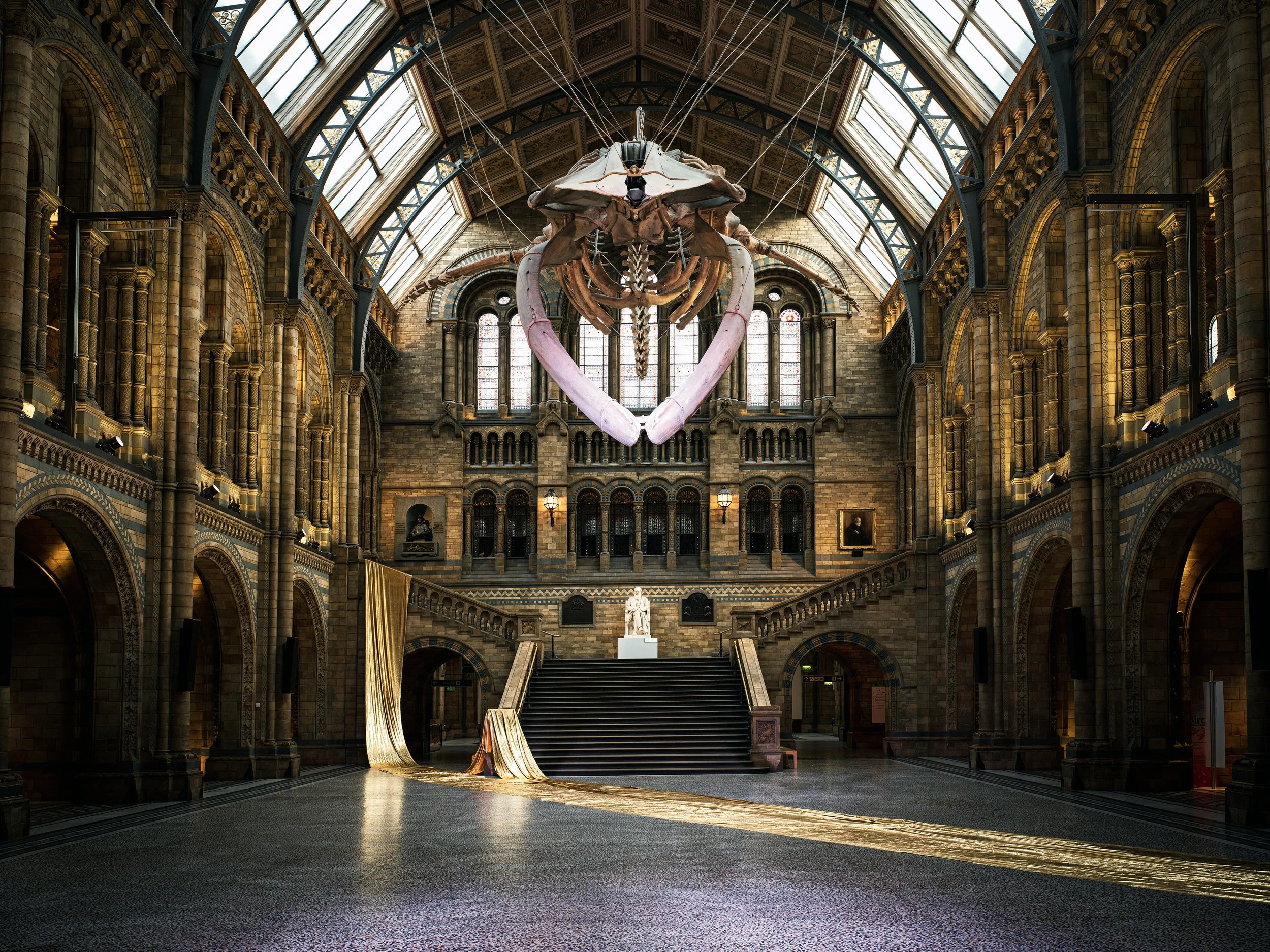
Lamya Gargash, The Natural History Museum (2024)
To continue reading this article, purchase a copy of Issue 14 here.