EARLY SAUDI PHOTOGRAPHY
IN CONVERSATION WITH DALIA HASHIM
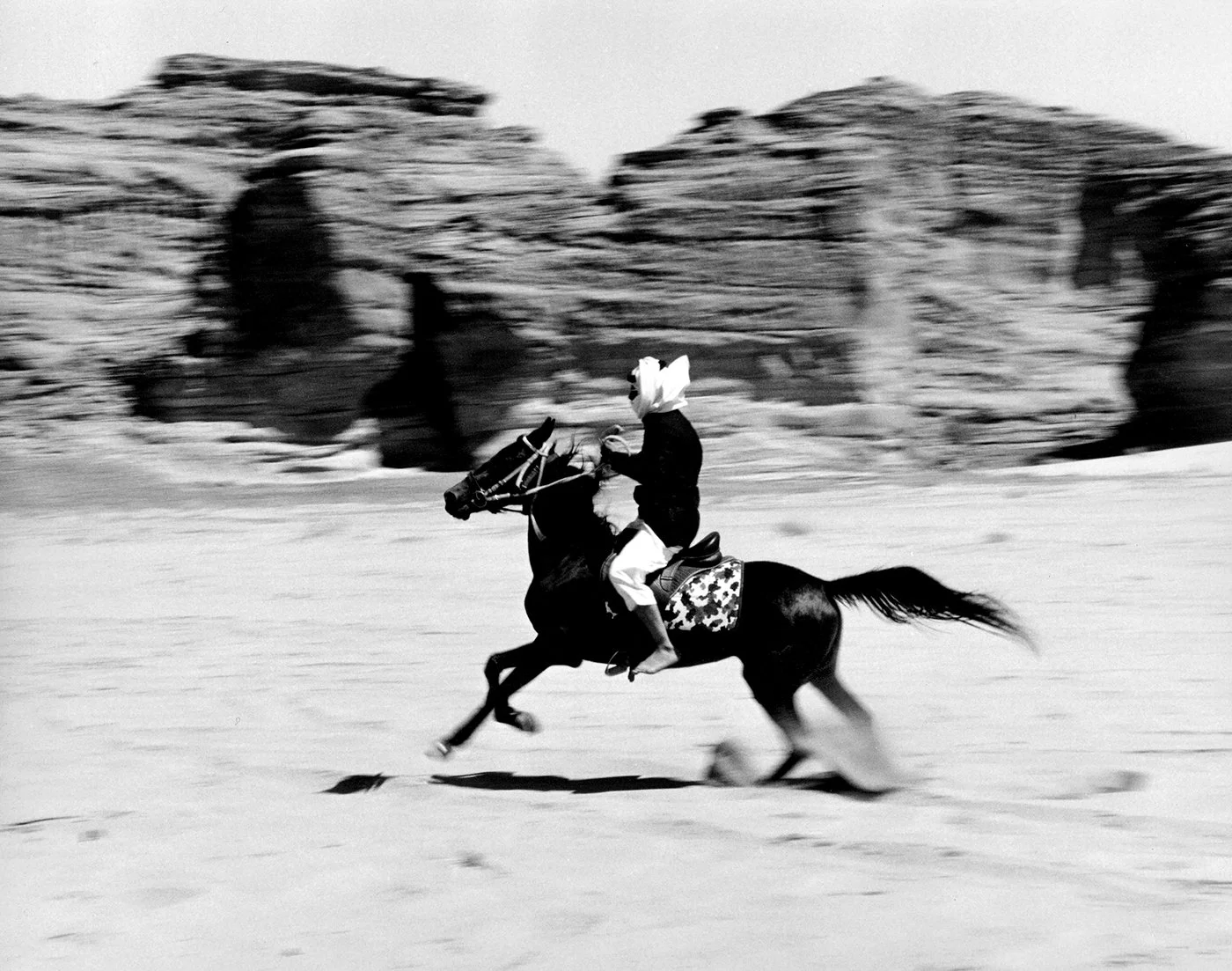
Rania A. Razek, Bedouin Rider (2006), AlUla, Silver gelatin print, Courtesy of the Artist
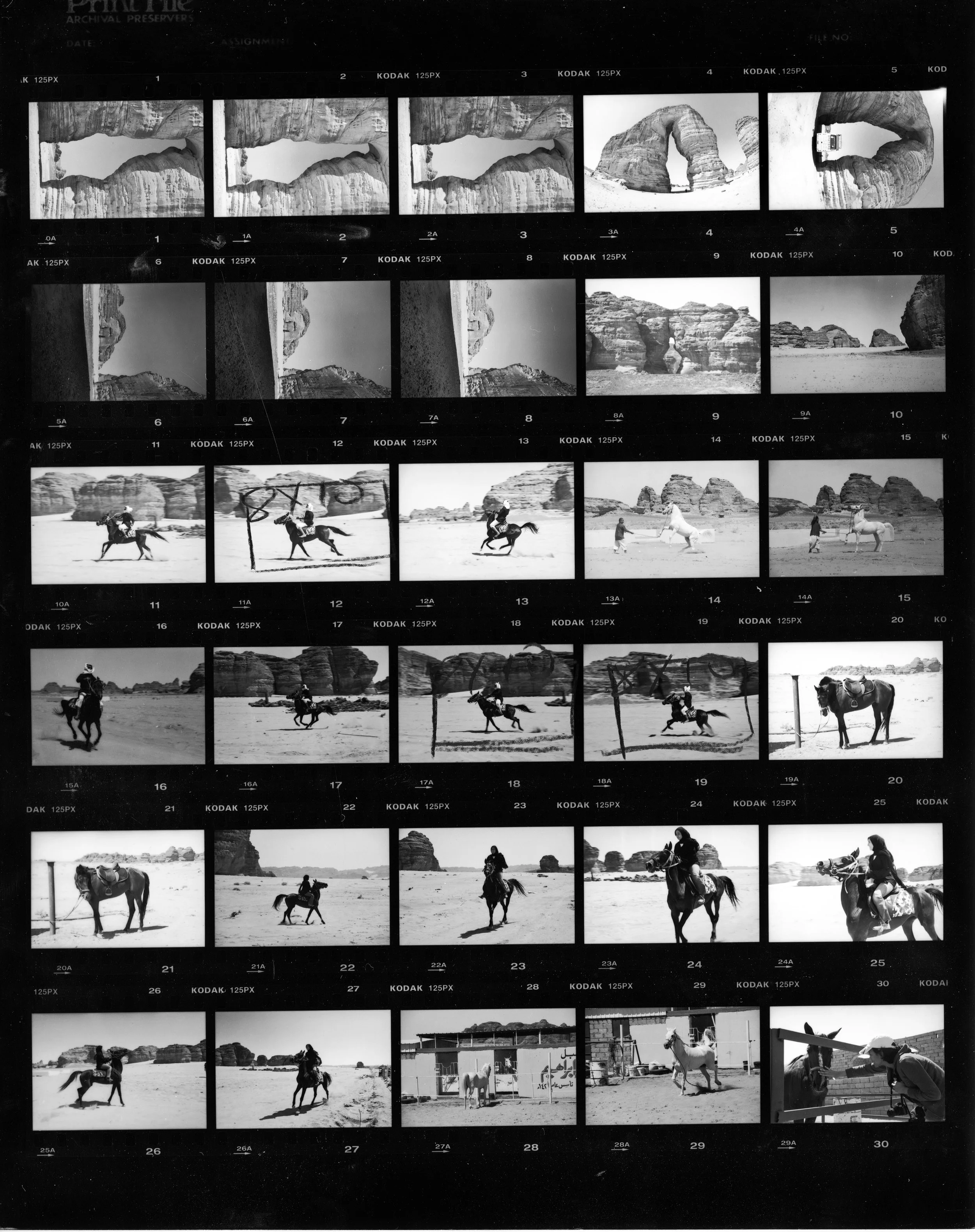
Rania Abdel Razek speaks the way a seasoned traveler glances at a map — familiar, amused, always slightly in motion. When relatives ask her, “When are you coming back?” her answer is reflexive, almost lyrical: “I’ve lived away for so long, I see myself as a citizen of the world.” And it shows. Long before Saudi Arabia’s cultural renaissance gained momentum, Razek was in the lecture halls of Dar Al-Hekma University, not just teaching photography but shaping it — curricula drawn with the precision of a lens, infused with a quiet insistence that the image matters. In the early 2000s, before DSLR had become a dinner-table acronym, she led a modest photographic pilgrimage north — to AlUla, the ancient city then still veiled in the folds of obscurity. Alongside her aunt, who shared an American-tinged love for the outdoors, and a curious convoy of expatriate teachers and students, she boarded a bus from Madinah and drove into the ochre-toned horizon.
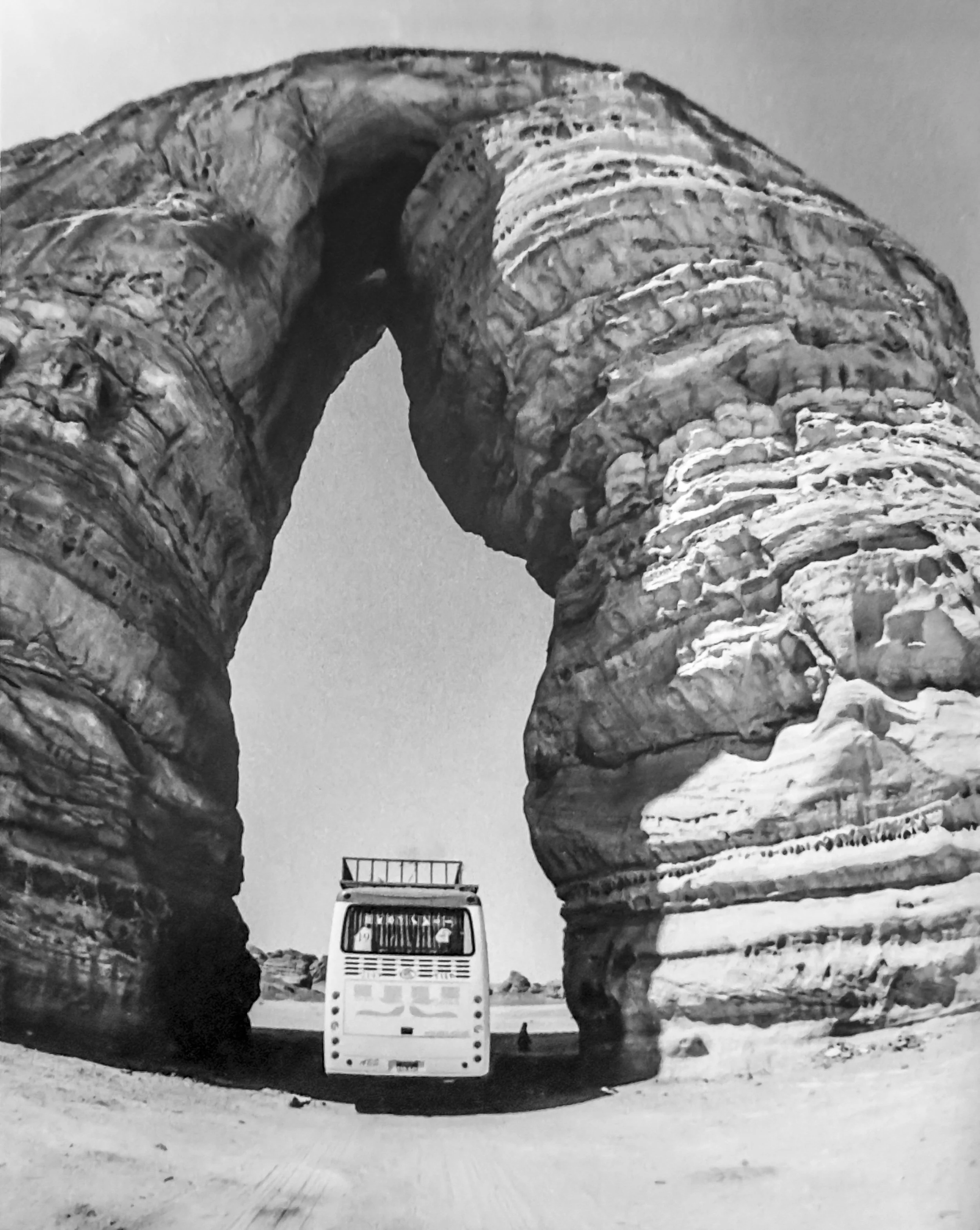
There, Razek was the lone Saudi in a group of outsiders, something she notes with both irony and affection. “Even though I’m part-Saudi, I enter as a visual foreigner,” she tells me. That sense of duality — half-rooted, half-roving — runs through her work like light through film. On that first visit to AlUla, the tour guide narrated the Nabatean past as his ten-year-old son chased shadows between the stones. Razek shot in black and white on a wind-up Nikon, the desert swallowing sound, the light stretching long and golden at dawn. Later, her students would say, “Is this our country?” and she would reply, “Yes, it is.” Today, AlUla has become a postcard destination, but Razek’s memory clings to an older version, where you could drive right beneath Elephant Rock, help a stranger whose car got stuck in the sand, and capture, perhaps by accident, a galloping horse mid-frame. What remains with her isn’t just the photograph, but the grace of the moment before the shutter clicked.
Dalia Hashim: Your photographic journey spans over two decades, during which you’ve exhibited in numerous countries and curated high-profile exhibitions. How would you describe the evolution of your artistic vision since you first began your career? What have been the most transformative experiences along the way?
Rania Abdel Razek: My love for photography began at the age of ten. I wanted to document everything — from school moments with friends to family gatherings - capturing life as it unfolded. In many ways, you could say my early passion was rooted in documentary photography. That passion continued from high school to university, where I worked as a photojournalist for the student newspaper. I pursued a degree in Visual Media Communications, expanding my skills into photography and videography. From working in television stations to eventually teaching photography and video editing, each chapter deepened my commitment to visual storytelling.
DH: You created the first women’s photo club in Saudi Arabia. What prompted you to establish such a platform, and what impact do you believe it has had on nurturing female talent in the Kingdom?
RAR: During my time at Dar Al-Hekma University, I was approached by several students with a shared desire to explore photography beyond the classroom, to experiment creatively, and to connect through visual storytelling. What began as a simple group trip with twelve enthusiastic students quickly evolved into something bigger.
The photography club we founded in 2003 became a thriving creative community, growing steadily each year. It gained recognition beyond the university, leading to student exhibitions in Saudi Arabia, Dubai, England, France, and the United States. The club provided a platform for students to showcase their talent internationally and paved the way for student exchange exhibitions with universities in the U.S., fostering cultural dialogue and artistic collaboration.
…
RAR: There’s something incredibly moving about witnessing — and being part of — a cultural shift, especially when it comes to representation in the arts. Photography Through the Eyes of Saudi Arabian Women was a landmark that gave visibility to a whole spectrum of creative expression. It was not just a platform for women in photography, but also for a broader selection of voices in Saudi’s art scene. The fact that we now see a more inclusive spotlight, where creativity is celebrated across gender lines, speaks to real progress. It’s as if the arts have become this unifying force. There’s a celebration of the cultural diversity of locals, international artists, and audiences in Saudi Arabia — a rare and meaningful convergence of color, light, and story.
DH: Your teaching experience spans prestigious institutions such as Dar Al-Hekma University, The American University, and University of the District of Columbia. What do you see as the most critical elements in fostering creative expression and technical expertise among emerging photographers?
RAR: Technical skills can be taught and refined with practice, but true artistry — the kind that resonates and moves people — comes from within. It’s that inner voice, the spark of imagination or emotion, that brings originality to the technique. It’s like giving an artist a paintbrush and teaching them how to hold it. I give them a camera, and they begin to play: with light, with shadow, with color. Then something beautiful emerges. That’s where talent and personal expression really shine.
DH: Looking forward, what are some of the themes or projects you hope to explore in your work? Are there any topical cultural or social issues you feel compelled to address through your art in the coming years? What do you see as your legacy within the broader narrative of Saudi Arabia’s cultural evolution?
RAR: Wherever the wind takes me, that’s my motto when I set out on photo trips or dive into new creative projects. I draw inspiration from other photographic artists, and in turn, I hope to inspire others. Every artist has a story, and behind every striking photograph lies a moment, a memory, a meaning. Photographs are a photographer’s journal.
Saudi Arabia is moving forward at an incredible pace, and in doing so, it has opened doors for countless artists to gain exposure. I believe this momentum will continue for generations, and I want to be part of that movement, helping to bridge cultural arts across borders and connecting artists and audiences around the globe. As an educator, I aim to reshape how future generations think, create, and connect. I hope to encourage them to get lost, discover themselves, and ultimately create something new that matters.
To read more, email Tribe for a copy of Issue 14.