Abdulrahman Albaker, Afraa Ahmed, Ali Al Shehabi, Ali Zaaray, Farah Al Qasimi, Hicham Gardaf, Louisa Babari, Manal AlDowayan, Maya Ines Touam, Moath Alofi, Mohammed Nammor, Moustapha Azeroual, Moustapha Lamrabat, Nada Harib, Nadia Bseiso, Nadia Kaabi - Linke, Reem Falaknaz, Rehaf Fawaz Al Batniji, Sara Naim, Taysir Batniji, Thana Faroq, Yassine Ismaili, Youssef Nabil, Ziad Antar, Leila Bencharnia
CURATED BY MERIEM BERRADA
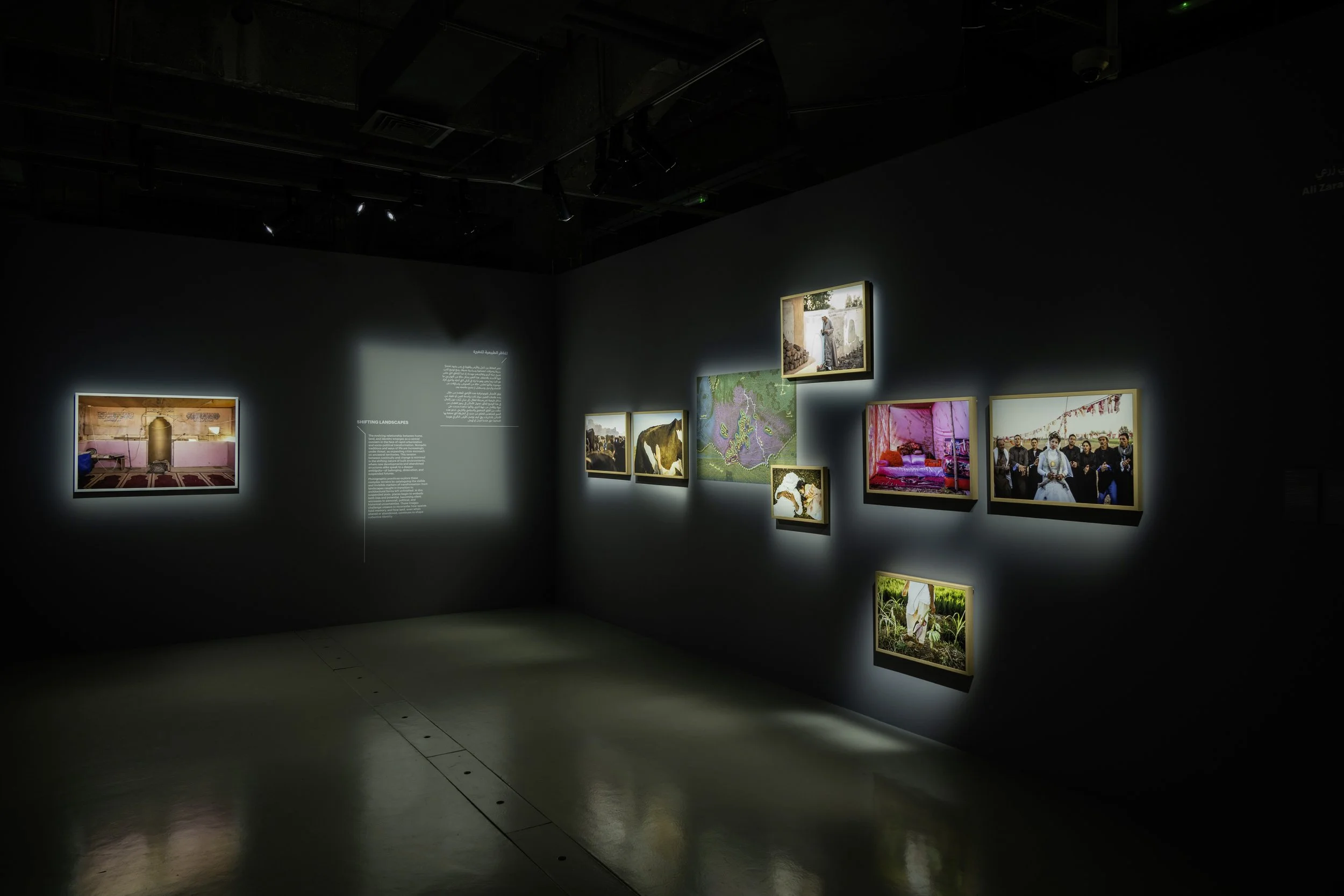
As I Lay Between Two Seas offers a meditation and a poetic journey on belonging, identity, and home. Featuring works by twenty-five artists from the WANA region, the exhibit shapes a visual environment that interprets these notions not as resolved or fixed sentiments, but instead as ongoing productions informed by ruptures, fragments and spectral traces. Drawing from Stuart Hall’s understanding of “identity as a ‘production’ which is never complete, always in process”, the exhibit unfolds the multitudes contained within in-between spaces–of living, existing, remembering and resisting. Poetry forms a foundational block of the exhibition. The voices of Khalil Gibran, Mahmoud Darwish, Zeina Hachem Beck and others inform the curatorial pace and methodology of this gathering.
Borrowed from a photo series by Ali Al Shehabi, the title anchors the exhibit in a marine metaphor that speaks to the fluidity of selfhood. Like the sea, identity is never still; it moves, recedes, surges, and reshapes itself in relation to its shifting shores. The space between two seas becomes a threshold—at once abstract and tangible — where belonging is not given but continuously negotiated. This imagery resonates with the comprehensive reader “To look at the sea is to become what one is”, and echoes Etel Adnan’s navigation between abstraction and materiality, situating the exhibit’s curatorial weaving alongside her invitation to contemplate rupture as a space from which new imaginaries may emerge. As Omar Berrada and Sarah Riggs remind us in their introduction to “Another Room to Leave In”, in Arabic a line of verse—bayt—is also a house. This intertwining of poetry and space suggests that verse, in its concentrated and distilled form, can become a vast and sheltering dwelling. The exhibition proposes such poetic and visual spaces — realms in which to linger, reflect, and reimagine the possibilities of belonging.

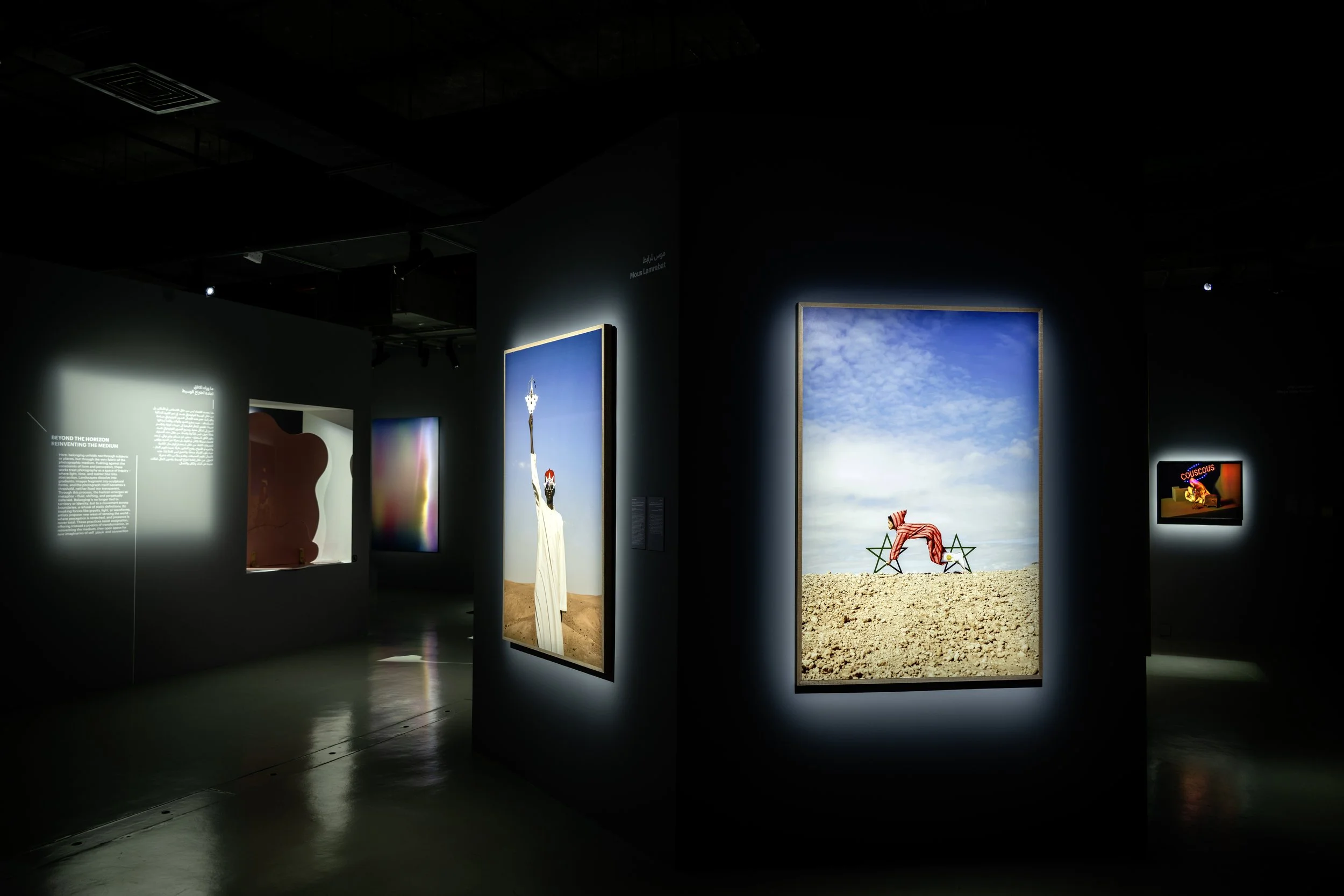
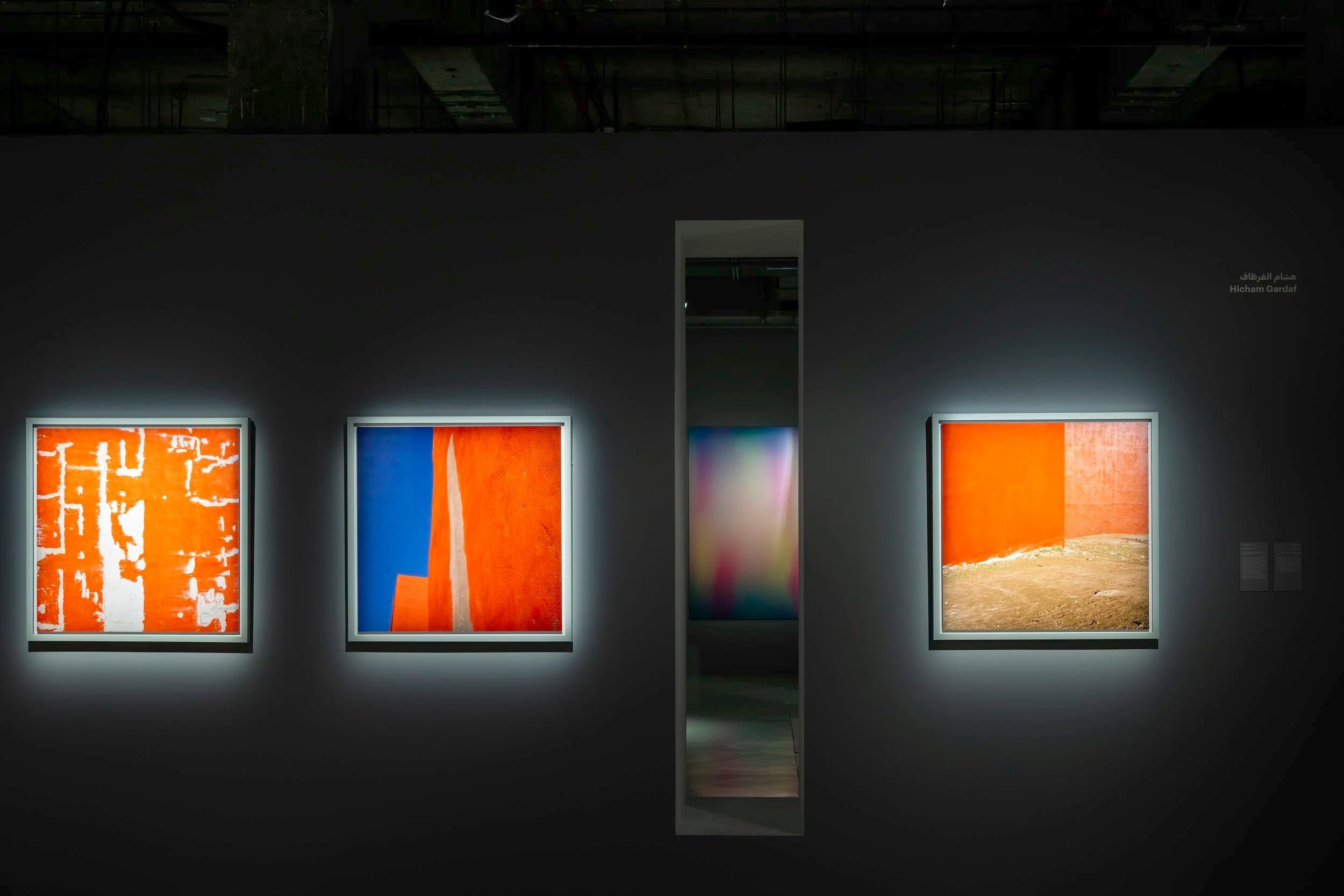
Courtesy of Tasweer Photo Festival Qatar, Qatar Museums, 2025
Installation views by Shaikha Ahmed Ali, Hasan Zaidi
The works in As I Lay Between Two Seas span three generations of artists from the Arab world and its diasporas. Individually, each body of work articulates a particular narrative of movement — temporal, physical, forced or voluntary. The selected artists resist cliched images and the narratives of displacement and migration associated with the region. Collectively, the artworks come together as an ensemble of productions of memories and (hi)stories that merge and form patterns through this acquired relationship. In this way, a multitude of voices and visions come together not as a single narrative but as a chorus of meanings and new possibilities. Here, we are invited to engage simultaneously with the individual works and their collective resonance. As we engage simultaneously with the individual works and their collective resonance, we comprehend their contributions to the broader discussion on migratory movements, rapid urbanisation, political upheavals, and the lived realities of exile.
These works further establish a commitment to resist linear narratives, compelling us to move beyond the simplistic oppositions of emigrant/local or exile/home to insist upon the fertile creativity of threshold. The works refuse closure, dwelling instead in a place where self and other are neither distinct nor fully collapsed, and where belonging is traversed by estrangement. To engage with these works is to stand at the edge of perception: between presence and absence, personal and collective, the visible and the unseen, the self and the other.
The exhibition also invites a perspective on the trace, as embodied in Derrida’s concept of différance and within the photographic medium itself with its inherent openness to liminality. Derrida’s différance disrupts binary oppositions of presence/absence or identity/difference to demonstrate that meaning is always contingent upon relationships. To belong, to identify, is often tied to something defined by what is absent, lost, or erased. Identity and belonging are shaped by a trace–a lingering imprint of what once existed but is no longer present.
This trace does not vanish; instead, it resurfaces and is remade each time we revisit our understanding of self or place. Integral to the diasporic journeys that have shaped the lives and work of many exhibiting artists is carrying forward the memory of what has been displaced or forgotten. This notion becomes a conceptual foundation for the exhibition as well as an essential navigational tool for the artists, enabling them to craft new cartographies of belonging — maps that trace loss while embracing the continuous element of transformation.
In The Last Tashahud, Moath Alofi documents desolated mosques that transcend their status as architectural relics; they represent spaces where what is absent may be as resonant as the visible or tangible. In the same vein, Afraa Ahmed’s works record the eight phases of the moon while also harnessing elements from traditional Yemeni architecture (AlQamariya), specifically the moon-shaped windows that lend their name to the artwork’s title. She reflects on these enduring cultural markers as powerful connections to collective memory that traverse expanses of time and space.
In works like those of Thana Faroq, belonging is not merely a narrative of loss but also an act of creation. Faroq’s photographic project How shall we greet the sun navigates between Yemen and the Netherlands, chronicling the life of a group of young women refugees, including Faroq herself. Her lens documents the emotional process of forming new identities and roots from within the confines of nostalgia. Faroq’s project is disorienting in its refusal to “settle”, in accordance with what Edward Said called the “ruins” of exile. For Said, exile fractures existence, turning belonging into a site of perpetual negotiation, both a wound and a space for reinvention.
Nadia Kaabi-Linke’s Crashed Memories Twenty- Eleven joins this ambition of creation from a different perspective. The displayed photo series interweaves the private and the collective to present imprints of geopolitical memories– the Arab Spring–with her personal travels throughout different cities in Tunisia. In these works, damage itself becomes an agent of creation and reactivation. The artist’s original files were corrupted during the saving process, and digital recovery yielded entirely new compositions. Kaabi-Linke reasserts here the possibility of becoming and renewal in the face of turmoil. Alternatively, Ali Al Shehabi’s visual recollection As I Lay Between Two Seas unveils an identity and a sense of belonging that is at once fractured and mended. Having spent much of his life abroad, the artist must now navigate the local Bahraini culture that is foreign to him, using personal reconstructions of spaces, family, and traditions. His work attempts to make sense of home and the many layers that compose it through a visual narration that relays memories of the past and his recent return to Bahrain.
…

Thana Farouq, Nadia Kaabi-Linke, and Youssef Nabil
Courtesy of Tasweer Photo Festival Qatar, Qatar Museums, 2025
Installation view by Wadha Al-Mesalam
Mustapha Azeroual’s Radiance extends this conversation into abstract realms, defining the horizon as a space of liminality. In his luminous landscapes, earth meets sky, past and future converge and presence dissolves into absence. Azeroual’s photographs blur the boundaries of perception, merging natural landscapes with digital distortions to create visions that are at once representational and abstract. In the context of this exhibition, Radiance can be read as a suggestion that belonging is not a destination but a horizon, always in flux. In Resurgence, he further interrogates the photographic medium itself, treating it as both a fragment and a sculptural form. Sara Naim continues this exploration of the notion of boundary through sculptural photography and installations, questioning our perception of limits and thresholds. In Shift, she invokes physics and metaphysics to reflect on what it means to exist in a universe governed by fluidity and change. By invoking time objects such as gravity and waveforms, she creates fractured impressions of space and time that speak to the transient nature of belonging and the impermanence of identity. Leila Bencharnia’s sound piece An Instance of Dry Land offers a meditative interlude within the visual journey of the exhibition. Composed from crackling, burning, and breath-like textures, the work evokes the emotional dissonance of displacement and isolation, inviting listeners into an intimate sonic space where the search for coherence and belonging unfolds in the absence of stable ground.
The selected artists presented in As I Lay Between Two Seas are as singular and diverse in their practices as the contexts from which they draw. They expand the vocabulary of representation and stand interconnected in their collective exploration of identity, belonging, and displacement, while harnessing the possibilities that emerge from discontinuities, whether temporal, historical, ecological, or cultural. Discontinuities that serve here as both identity-shaping events and creative catalysts for the artists to redefine the medium through which they express identity. While some include new threads of text, objects, or technology, others remain faithful to the documentary style of photo-essay tradition. Yet, all the works dwell in the in between of longing and displacement, imagining new possibilities for rootedness in unfamiliar and ever-shaping terrains. Through this lens, the Sea in Al Shehabi’s phrase becomes both metaphor and method–a space where belonging is a negotiation, not a destination; a space that allows us the opportunity to rethink our ties to home, selfhood, and understanding.
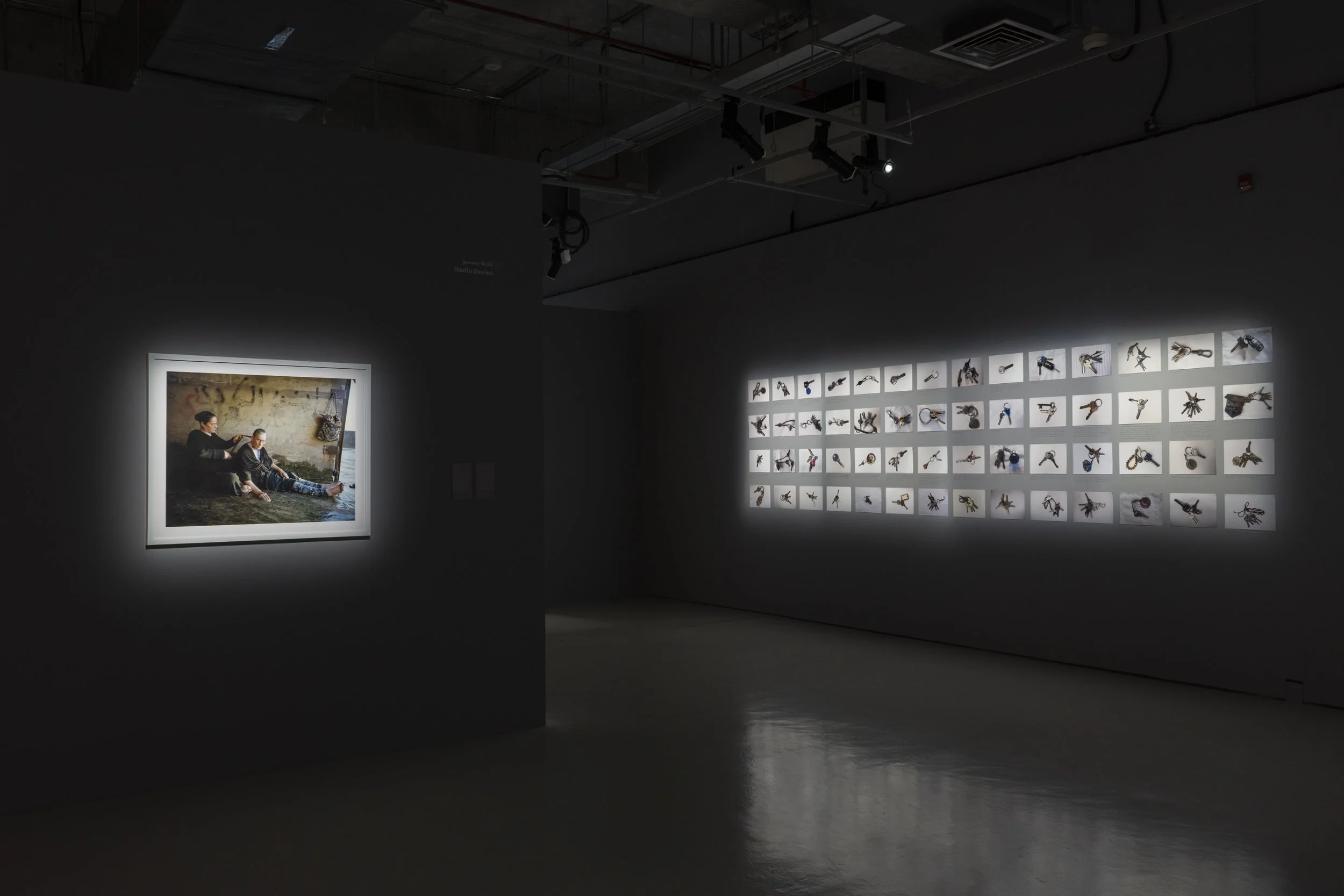

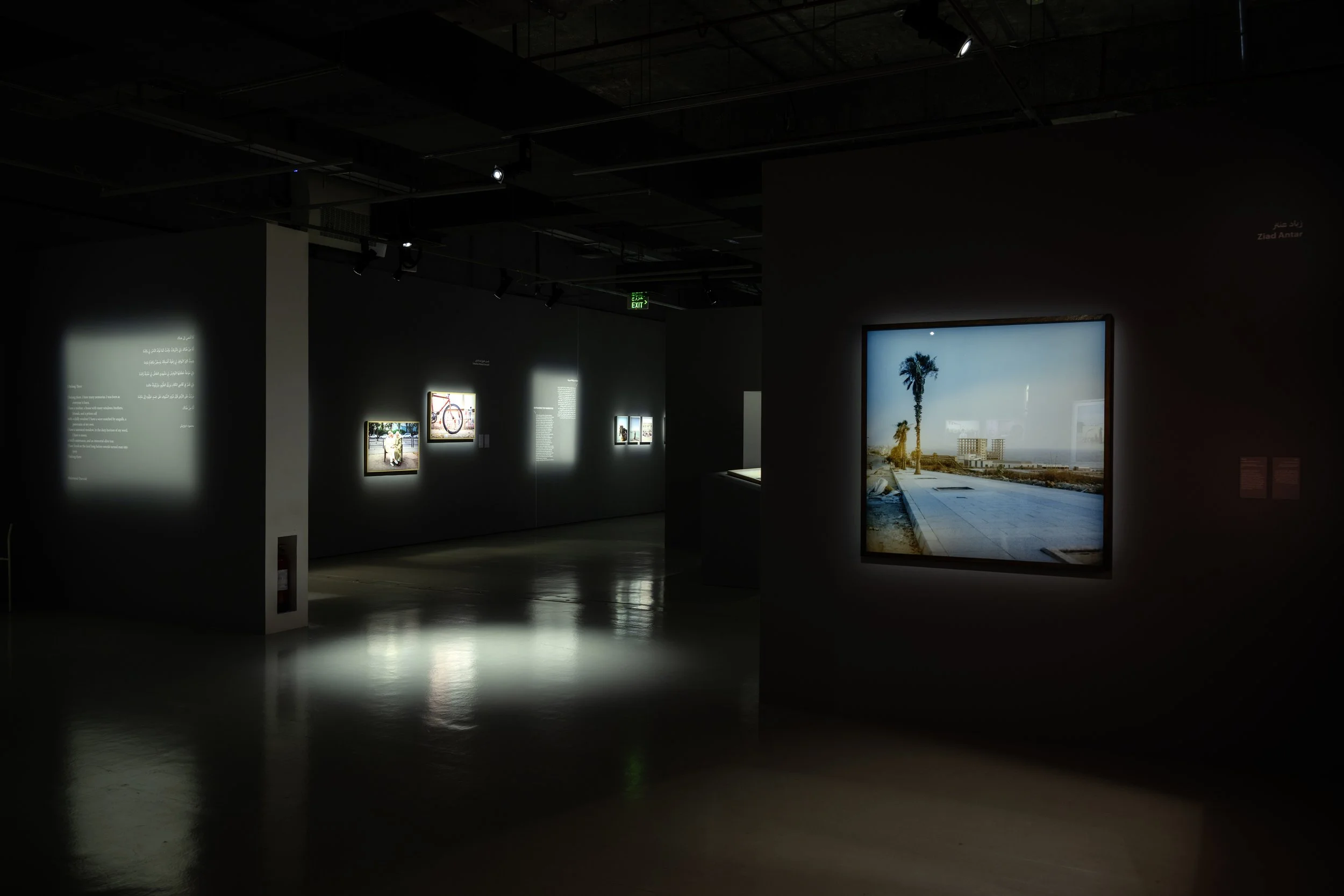
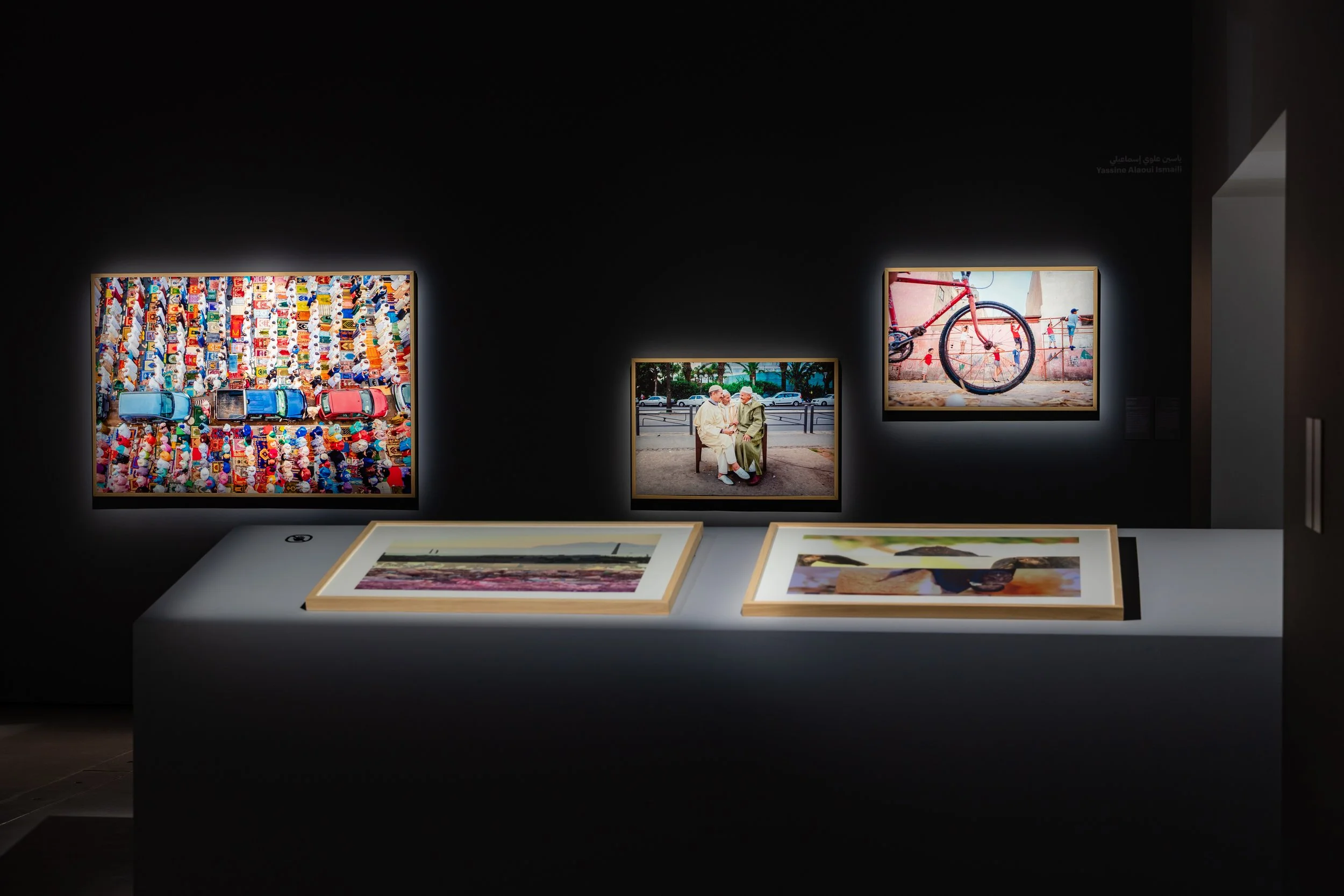
Top to bottom: Nadia Bseiso and Taysir Batniji,
Sara Naim and Louisa Babari, Ziad Antar
Courtesy of Tasweer Photo Festival Qatar, Qatar Museums, 2025
Installation views by Shaikha Ahmed Ali, Hasan Zaidi
To read more, email Tribe for a copy of Issue 14.