Your Ghosts Are Mine: Expanded Cinemas, Amplified Voices at ACP–Palazzo Franchetti
BY ANNA MAYDANIK
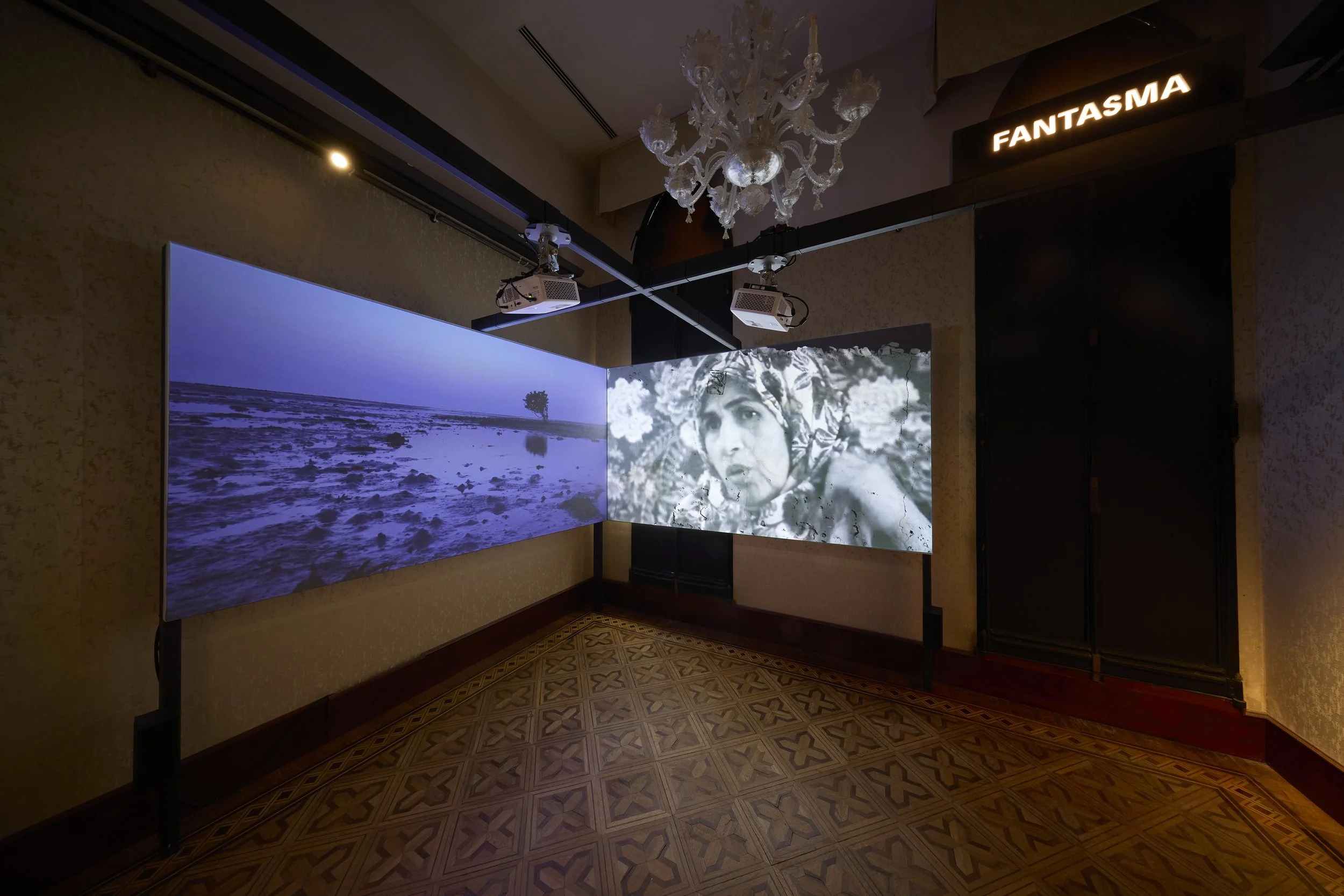
Courtesy of Qatar Museums.
Installation view by David Levene.
Qatar Museums presented Your Ghosts Are Mine: Expanded Cinemas, Amplified Voices at ACP–Palazzo Franchetti during the 60th Venice Biennale. Co-produced with the Doha Film Institute, 58 artists from both the Arab world and the Global South explored deserts, ruins, fires, borders, exile, deliverance, fantasma, dance, cosmos, and futurism through the moving image.
The artists within Deserts: There Are No Empty Spaces experience the desert as a place for meditation and transcendence; a great arena for potential; and simultaneously, debts, as in Deserts (2023) by Faouzi Bensaïdi (b. 1967, Morocco), which follows debt collectors into the Moroccan Sahara.
These films frame the desert as a passageway, as Hamida Issa (b. 1976, Qatar) does in her autobiographical documentary Places of the Soul, about the first Qatari woman to visit Antarctica.
Hassen Ferhani (b. 1986, Algeria) profiles Malika, the keeper of a local tea shop in the Sahara Desert, in 143 Sahara Street (2019). The only passage for Malika through time and space occurs in her transient customers. The desert is not a vacuum, but an extension of her steady, open heart.
Ramata-Toulaye Sy (b. 1986, Senegal) presents Banel & Adama (2023), and Amin Sidi-Boumédiène (b. 1982, Algeria) presents Abou Leila (2019), two films that experience the desert as a stage for visions of the future in mirages or revelations. Toulaye and Sidi-Boumédiène present journeys between barren sand dunes and a ruthless sun as pilgrimages to higher consciousness—one through madness, the other through enlightenment.
The artists of Ruins experience modern life as an interruption. In Lida Abdul’s (b. 1973, Afghanistan) Dome (2005), a four-minute looped video, a boy in a roofless Afghan mosque stares into the deep blue sky, transfixed by his own spinning movement and the heavens—until a helicopter breaks the spell.
Inspired by Egyptian writer Mohamed Mustagab’s The Sunflower (1983), Wael Shawky (b. 1971, Egypt) explores the ruins of his childhood through the three-part film Al Araba Al Madfuna I–III. Mathaf: Arab Museum of Modern Art in Doha commissioned the third installment on view. The film follows children living in Al Araba Al Madfuna, a village near the archaeological ruins of an ancient city, as they dress up and dig tunnels, searching for treasure. With inverted colors, the film transforms the limitations of the past into childhood’s freedom of imagination.
Basim Magdy (b. 1977, Egypt) films a moving shot of his father trailing through dystopian New Cairo, swinging a shining lamp on a sunny day, in My Father Looks for an Honest City. Written after the ancient Greek philosopher Diogenes’ Cynic, Magdy’s father searches for “an honest man.” Shot on Super 8, Magdy considers ruins in transferring this archaic, saturated material to HD.
Fires: The Flames of Resistance follows characters who find power in absence and grow from beds of ash. Fires erupted after 2010, when a young man in Tunisia set himself on fire in protest of police harassment and his governor’s refusal to engage. His death inspired uprisings against autocracy throughout the Arab world, culminating in the Arab Spring. The films in The Flames of Resistance touch on the warmth, energy, and destruction that revolution requires to proceed. Characters gather around fires in shelter, as in The Cave (2019) by Feras Fayyad (b. 1984, Syria), and around heated broth, as in the Palestinian refugee camps of Damascus that Abdallah Al-Khatib documents in Little Palestine, Diary of a Siege (2021) (b. 1989, Syria). Some characters become enamored with fire, as in Harka (2022) by Lotfy Nathan (b. 1987, Egypt), while others incorporate it into their bodies, as in Dirty, Difficult, Dangerous (2022) by Wissam Charaf (b. 1973, Lebanon).
The moving images of Borders: One Day the War Will Be Over share the powerless individual’s fears that grow within and shape the ever-present, surrounding Other. Ahmed Saleh’s (b. 1980, Jordan) Night (2021) is a stop-animation that follows a woman who sees her missing child for the last time. From the tender dynamic between the woman and the night, a border forms between life and death, past and future.
Engulfed by limitations, Ghost Hunting (2017) by Raed Andoni (b. 1967, Palestine) shows Palestinian prisoners recreating their time within an Israeli interrogation center, expanding their internal landscapes. In a mirroring, reconstructive manner, Randa Maroufi (b. 1987, Morocco) shoots Ceuta’s Gate (2019) (also known as Bab Sebta) on a studio set, presenting the border between Spain and Morocco.
“Foreigners Everywhere” was the title of this 60th edition of the Venice Biennale, so Exile: Where Is My House? sits at the heart of Your Ghosts Are Mine.
The Doha Film Institute and Art Basel collaborated on a Self-Portraits project for which Elia Suleiman (b. 1960, Palestine) made Chasing the Dazzling Light (2022). A short-video self-portrait, Suleiman finds herself as both a subject of the film and of her life, between her homeland and exile. Jessica Beshir (b. 1988, Ethiopia) directs and films the feature-length black-and-white portrait of khat, both as a leaf with stimulant effects that Sufi Muslims chew during religious rituals and as an economic asset for Ethiopia. Suleiman and Beshir trace the liminal space that changing times create for lost and grounded individuals.
Deliverance: Where the Hearts Open focuses on the survival and expansion of women in tight situations. Naziha Arebi (b. 1984, UK) Freedom Fields films a football team of young women after the Libyan revolution, and in the sober reality that followed the Arab Spring.
I Am Afraid to Forget Your Face by Sameh Alaa (b. 1987, Egypt) follows a young man who wears a burqa to attend the obituary ceremony of the young woman he loved. From his perspective, through her feminine world, he meets her again.
Artists who question the legitimacy of their education and their history illuminate subjects waiting to be mourned. When filmmakers honor the deceased, they conjure ghosts on-screen. Giving the liminal space of exile a motif, Fantasma: Ghost Images similarly centers Your Ghosts Are Mine.
Hassan Khan (b. 1975, British-born Egyptian) presents a tender Jewel (2010), a quiet re-enactment by two men of a scene Khan witnessed from the corner of his eye while riding through Cairo. Shot on 35mm, this endless loop simply shows two men dancing beside each other, two monuments to haabi music, urban with roots in the Egyptian working class.
The Last Frontier ties together three films as images of a place that is not postcolonial but anticolonial: stories about the space race in The Lebanese Rocket Society (2012) by Joana Hadjithomas and Khalil Joreige (b. 1969, Lebanon); icon-building in The Dam (2022) by Ali Cherri (b. 1976, Lebanon); and archival work in In the Future They Ate from the Finest Porcelain (2015) by Larissa Sansour (b. 1973, East Jerusalem).
The final leg of Your Ghosts Are Mine opens with the introduction: “Along with friend and musician Fatima Al Qadiri, [Sophia] Al Maria coined the concept of ‘Gulf Futurism.’ In Sad Sack, a recently published collection of writings, Al Maria explores the possibility that, in some respects, the Gulf is already living within the future imagined by those in the West.” Sophia Al Maria (b. 1983, Qatar) presents a cinematic diptych, The Future Was Desert II (2016) and Black Friday (2016), about the neutrality of shopping malls and oil rigs in a world at war.
Anna Maydanik is a writer and gallerist who provides creative consultation to filmmakers, artists and writers to develop projects. She is based in Kyiv, where she has a gallery, Анна showing contemporary photojournalism and the Ukrainian avant-garde. She is currently in pre-production as a writer and producer on several film projects, both fiction and documentary. She is the editor and writer for an upcoming photo project, titled “Concierges of Kyiv.”